
Thoughts: Familiar Places
Dagenham
Over forty years in consultancy, some places have kept drawing me back. Dagenham is perhaps the best example — a place where freight, industry, regeneration and transport infrastructure have repeatedly intersected with my career.
Ian Brooker | 24th August 2026
One thing I’ve noticed over forty years in consultancy is that our work rarely spreads evenly across the country. Instead, it clusters. One successful commission leads to another. Clients move organisations. Colleagues recommend you. Before long you know a place inside out.
For me, nowhere illustrates that better than Dagenham. It’s not glamorous, but it has its own gritty personality, and is a part of London which is of considerable importance for its industrial base and logistics industry.
The area is particularly important as the only place where UK rail freight can gain access to HS1. HS1 can carry rail freight direct to the Channel Tunnel and on to continental Europe. This means faster journeys than the route via South London and Kent. Equally importantly, HS1 can accommodate standard European wagons which are bigger than those we use in the UK.
Of course Dagenham is also on the River Thames and has a major wharf used by Ford and several other wharves specialising in commodities such as scrap or liquid products. All this just a few kilometres from the M25 via the A13 and also just a few kilometres from the centre of London.
What an opportunity it should be: superb road and rail access and active but underused wharves! Indeed, the area is becoming a hot spot for logistics hubs, but up to now without much use being made of the rail facilities.
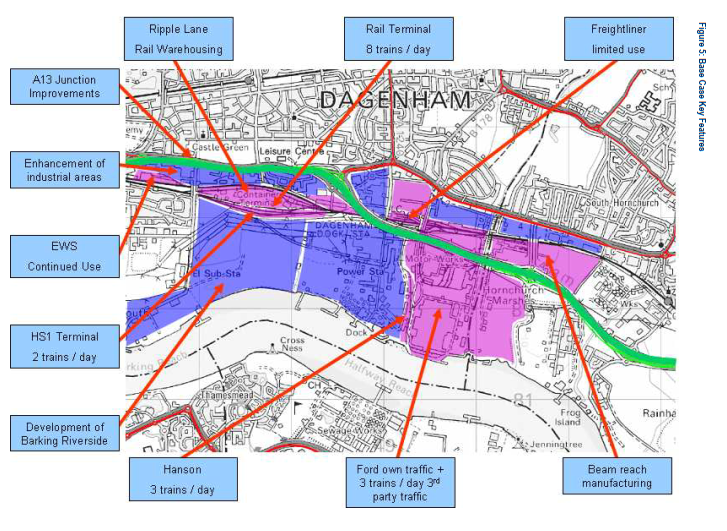
I first visited Dagenham because Ford was British Rail’s biggest automotive customer when I worked on business development for British Rail’s automotive business in the 1990s. Ford took a firm hand steering our product development for the Channel tunnel which was under construction at the time. HS1 was actually routed through the Ford site – hot on the tails of the new A13 which also dissected the site. It’s fair to say that Ford weren’t exactly happy to have two major bits of infrastructure running across their estate, but we were at least able to provide them with excellent access to HS1 – the only site with a direct, continental gauge, connection.
When I became a consultant in 1993, one of Ford’s logistics providers became my first client as I helped them obtain a freight grant and to rationalise their activities on the vast Dagenham site.
Soon after I became part of the team on a major project called Dagenham 2000 which thoroughly analysed all of Ford’s activities on the estate and recommended a strategy to make better use of land, including developing land for suppliers adjacent to the site. We used to have early team meetings over a full English in Asda next door to Ford because of sensitivities if we met on site. Ford have always used rail freight to and from Dagenham, with a complex of rail sidings at the heart of the site. A challenge was to find a way of making the internal rail operation operationally efficient, and attracting in third rail freight party users.
We had landscape architects on the team who took great exception to the Ford habit of painting any street furniture yellow. On our last day, after six months, we left the site driving past someone repainting a lamppost. Yellow. But the work did leave a lasting impression of Ford Dagenham as a logistics hub with true trimodal access and tremendous potential.
Later I undertook some research for Barking and Dagenham Council and delivered several projects and freight strategies over several years for the London Thames Gateway Development Corporation, including land use and rail freight access studies for Dagenham Dock. This included identifying how the Ford site could be opened up for third party rail freight.
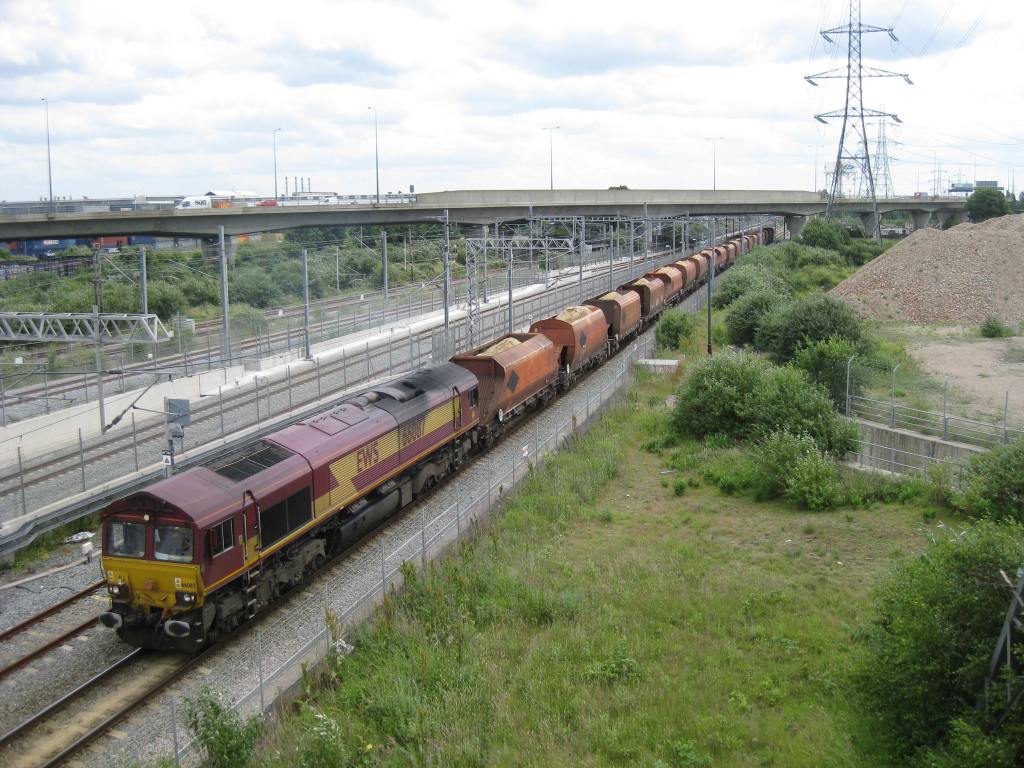
I gained an understanding and respect for the multitude of businesses in the area, many performing unsightly or unpopular tasks such as empty container storage, scrap and recycling, or tank washing. Nobody wants these activities next door, but they are vital to any economy. As the area became regenerated for housing and more attractive land uses, these businesses have had to relocate further and further away from their customer base. I also found that many of the businesses traded with each other, and disrupting those relationships potentially reduced efficiency and added to road traffic.
Next door to the Ford Estate is Barking Rail Terminal which has been underused for decades due to a combination of poor road and rail access, inefficient size and shape, and land ownership changes and challenges. Yet in the past it was used as an intermodal terminal, and it also has good access to HS1.
In more recent years I worked on projects for Barking and Dagenham and the City of London to promote redevelopment of the Barking terminal and to look at the potential for rail and river access to the City’s proposal to relocate city markets to the area.
Separately, it has recently been announced that Network Rail and its development partners are taking forward plans for the Barking terminal as a major rail-based logistics hub. I wasn’t involved in developing these latest proposals, but it is very good to see renewed plans for a site whose potential has been recognised for so long.
Meanwhile the Ford site is still a unique trimodal development opportunity.
I’ve lost count of the number of projects I’ve completed in Dagenham, and of site visits to huge businesses or obscure industrial estates.
Looking back, what strikes me is how each project grew naturally from the last. That’s one of the pleasures of consultancy. You don’t just learn about a place, you become part of its story.
When clients trust you, familiar places keep calling you back.
Discuss a project
If you’d like to explore how we can support your work, get in touch.

