
Thoughts: Freight & Logistics
The Real Cost of Freight Disruption
Disruption is usually measured in minutes lost. For freight, the real costs can be much wider — affecting vehicles, drivers, supply chains, customers and ultimately the economy.
Ian Brooker | 6th September 2026
There is an excellent article in the latest edition of CILT’s Focus looking at the management of transport disruption, based on a workshop bringing together people from across the sector.
I wasn’t involved in the workshop, so first of all congratulations to those who were. It addresses an increasingly important subject and raises some important issues around collaboration, information sharing, responsibilities and learning from disruption.
But reading the article got me thinking about an aspect of disruption which I believe deserves rather more attention: freight.
And particularly one question:
Do we actually understand the true cost of serious freight disruption?
Routine delay and serious disruption are different things
We have become quite sophisticated at measuring congestion and journey-time reliability. But I’m not convinced that we are nearly as good at measuring the relatively infrequent events when things go seriously wrong. That distinction matters particularly for freight.
Routine congestion (such as extended journey times typically found in peak hours) is a cost to a logistics operation, but it can usually be planned for. Operators adjust schedules, allow additional time, change departure times and gradually adapt their operations.
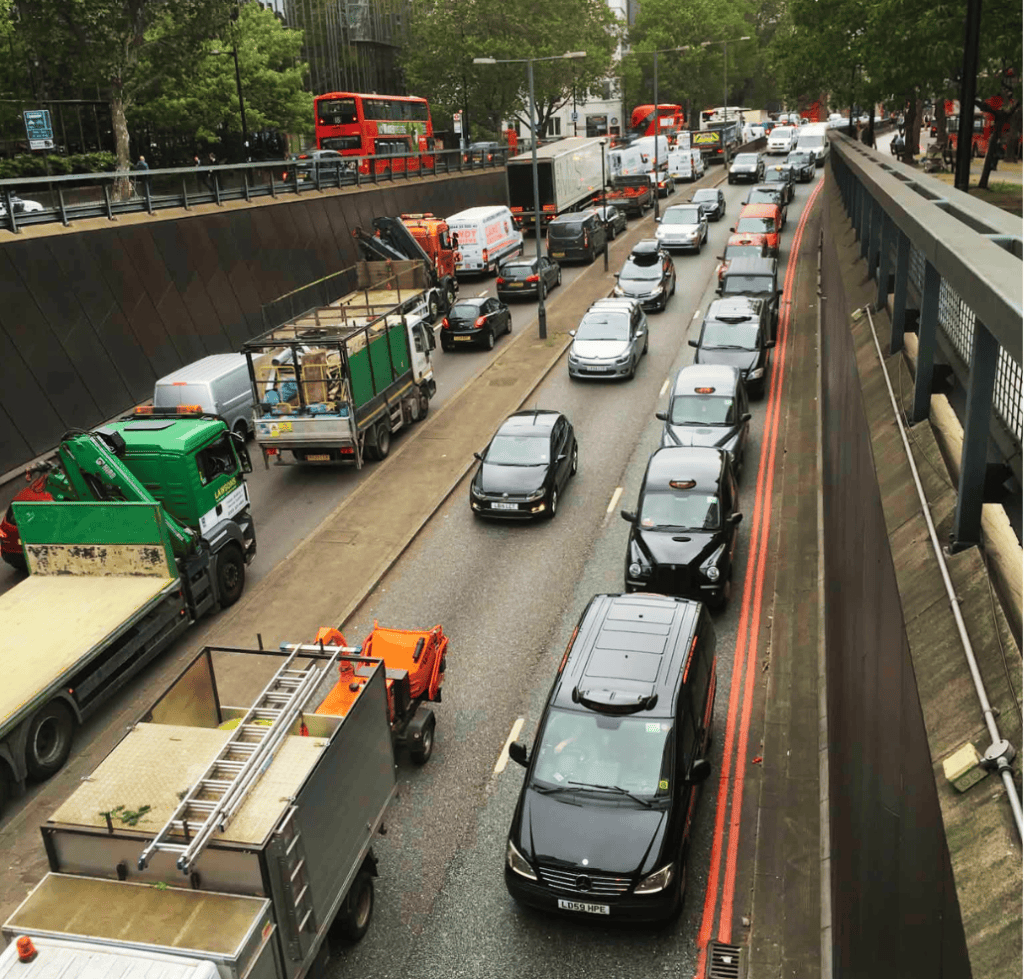
Serious unplanned disruption can be very different.
A motorway closure lasting several hours isn’t simply a bigger version of a ten-minute delay. It can result in missed delivery slots and leave HGV drivers running out of permitted driving hours — potentially stranding both driver and load even after the original incident has been cleared. It can lead to missed connections, additional vehicles and staff being required, and ultimately factories, distribution centres or other businesses not receiving what they need.
This isn’t a new concern for me. In 2018, Morag Robertson and I worked on WSP’s Managing Congestion study for the National Infrastructure Commission’s Future of Freight programme.
We made exactly this distinction. We found that estimates of the economic impact of freight congestion were primarily based on the operating costs associated with routine delay and generally did not capture the wider knock-on economic consequences of serious disruption.
One example we used at the time was Jaguar LandRover. The company reported that stopping production cost it £1.25 million per hour, while it held less than three hours of stock. That was a 2018 example and shouldn’t be treated as a current figure. But it illustrates the point beautifully. The cost of a lorry carrying essential components being delayed is not necessarily the cost of the lorry and driver’s lost time. It may be the consequences of what doesn’t happen because the lorry doesn’t arrive.
Recent DfT and National Highways work on Freight Value of Time and Reliability has made welcome progress in improving the way freight reliability is valued in appraisal. But it is necessarily focused largely on changes in normal journey-time reliability. Serious disruption presents a different challenge. Its consequences can vary enormously according to the commodity, its role in the supply chain and the circumstances of the individual customer.
That complexity should not deter us from trying to understand the costs. It should make us more determined to do so.
Are we measuring the wrong thing?
This raises another issue. Most conventional measures of road congestion and reliability are designed to describe everyday network performance. National Highways’ current journey-time reliability measure, for example, looks at the difference between observed journey time and the typical journey time and aggregates this across the network.
That’s useful. But it answers a different question.
Thousands of relatively small variations in journey time can dominate a network reliability measure. What interests me here is the tail of the distribution: the much smaller number of incidents which result in exceptionally severe disruption.
There have been attempts to measure this separately. TfL, for example, has explicitly measured hours of “serious and severe disruption” on its road network. Its definitions distinguish serious disruption from severe disruption, with the latter including incidents causing at least 20 minutes of additional journey time. (Transport for London)
But I am not aware of a generally accepted national measure or KPI that tells us how serious a major freight disruption actually is.
Should we measure the number of vehicles affected? The duration of a closure? Vehicle-hours lost? Tonnes delayed? The value of goods affected? Additional logistics costs? Lost production? The number of businesses affected? Or how long it takes supply chains to recover?
None seems entirely satisfactory.
A diversionary route isn’t necessarily a resilient route
The other danger is assuming that because goods traffic can theoretically be diverted, the problem has been solved.
For road freight, diversionary routes may involve significant additional mileage or roads that simply aren’t suitable for large numbers of HGVs. Weight limits, low bridges and road widths can restrict the options. Our NIC work highlighted exactly this problem.
And even where the road is physically usable, diverting large numbers of HGVs through towns and villages creates another set of consequences — congestion, noise, safety concerns and disruption to the people living there. We identified the potential conflict between HGV diversionary routes and local residents in our 2018 work too.
Rail freight presents an even more extreme version of the same problem. An alternative railway route may appear perfectly sensible on a map but be unusable because of loading gauge, capacity, train length, traction or other operational constraints. Sometimes the constraints can be remarkably obscure. When I worked in automotive logistics, the direction in which an automotive train arrived at a terminal was critical. Cars cannot simply be reversed off automotive trains. A diversion could therefore successfully get the train around an infrastructure blockage — but leave it approaching its destination the wrong way round. The solution might then involve sending the entire train many miles to find a suitable railway triangle, turning it, and bringing it back again. My rail operations colleagues understood these things instinctively. On occasions they intervened in the middle of the night to prevent a superficially sensible diversion from becoming an operational disaster.
It taught me an important lesson:
The existence of an alternative route does not necessarily mean that you have a viable alternative route.
Transferring rail freight onto road somewhere en route might sound like another solution. In reality it is rarely practical as an emergency response.
What about prevention?
All this matters for disruption management. Better information, communication, contingency planning and collaboration can undoubtedly reduce the consequences when something goes wrong. If we don’t understand the true economic and social cost of serious freight disruption, how do we make the business case for spending money to prevent it?
Maintenance, resilience measures, genuinely usable diversionary routes, additional network capacity and redundancy all cost money. Their benefits are much harder to demonstrate if the disruption they prevent is itself inadequately valued.
That potentially creates a vicious circle:
If the true cost of serious freight disruption is largely invisible, the business case for preventing it will also be understated.
This links closely to some of the work we are currently doing within CILT on the visibility and value of freight in transport decision-making. Freight is often economically important without being particularly visible. Serious disruption may be one of the clearest examples of that problem.
Our NIC study concluded in 2018 that there was no comprehensive research into the wider economic and business costs of congestion for the freight industry and its customers.
Eight years later, I am not convinced that we understand the consequences of serious freight disruption much better.
So perhaps the discussion prompted by the Focus workshop gives us an opportunity to ask a deceptively simple question:
How should we measure the true cost of serious freight disruption — and would understanding it properly change how much we are prepared to spend preventing it?
Discuss a project
If you’d like to explore how we can support your work, get in touch.

